
Recent Post
-
 WhatsApp Business Marketing: The Most Underrated Growth Tool for Small Businesses in 2026SEO
 -
 Short-Form Video SEO: How to Rank Your Reels and TikToks on Google in 2026SEO
 -
 The Rise of Zero-Click Searches: What It Means for Brands in 2026SEO
 -
 Micro Interactions and Motion BrandingSEO
 -
 Digital Transformation for Small Businesses: A Step-by-Step Guide to Building Your Online PresenceWeb Development

Make Winning SEO Strategies with In-Depth Google Search Layers
A deep grasp of search engine layers are essential for valuable SEO insights. It is fundamental to precisely set up your SEO, knowing what to avoid and what to follow— without ambiguity. Here we will uncover the architectural layers of Google search algorithms where SEO exists as a whole– not fragmentary.
This blog answers how SEO is tied to the grand design of Google’s search engine system and how these systems contribute to various SEO inputs– From webpage to SERP rankings and now AI results.
Table of Contents
What is Google Search Algorithm?
Google search algorithm is the digital architecture of a search engine to retrieve the most useful, relevant and trustworthy content for the given search query. It is made with a complex set of rules for crawling, indexing and ranking of the webpages.
Timely updates of search algorithms are necessary to implement or refine the rules for crawling, indexing and ranking.
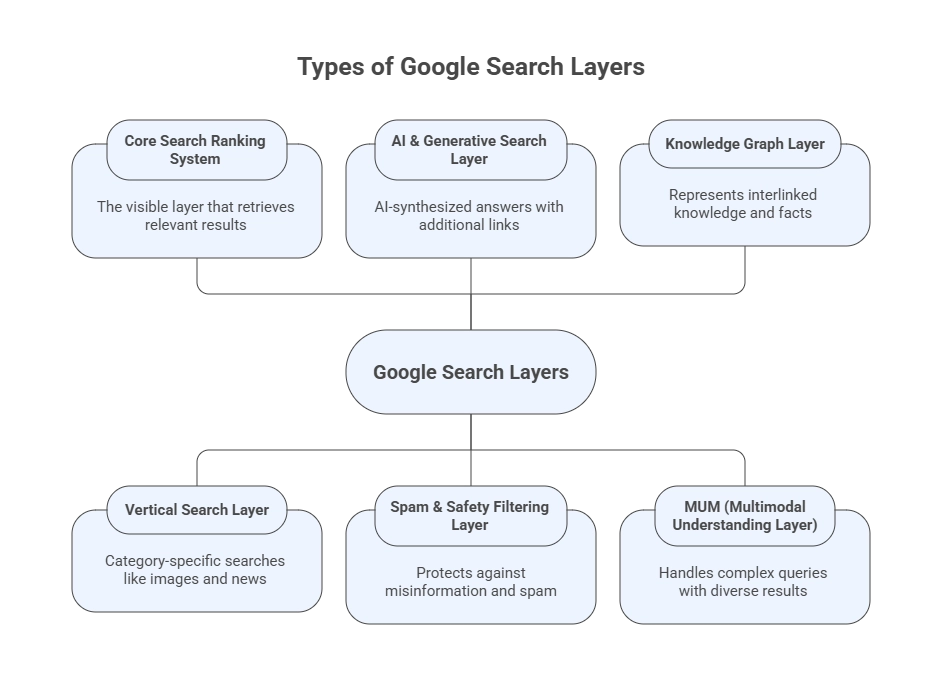
Types of Google Search Layers
When you make a normal search, Google’s core search system processes your query. But your search is not handled by a single algorithm. Behind the scenes, Multiple ranking systems work in parallel analyzing different aspects of the query – Content, quality, relevancy and user intent.
These systems work simultaneously and feed their signals into the main ranking system.
A basic understanding of these Google search layers will strengthen your SEO with precision and stability. You can’t force results through surface level optimizations.
This is the major reason for failed SEO attempts even when the “Best practices” seems to be in place. The missing piece is not just optimization itself, but knowing which system your work is influencing and how they affect ranking.
You don’t see such parallel results because it is not necessarily relevant until the final results are compiled from them and shown in the search results page.
1.Core Search Ranking System (The Surface Layer)
The Core Ranking system is the most familiar face of Google. It is the visible layer that we access through our mobile or PC. Think of it as the surface layer of the search while all the other layers are working in the background supporting and refining the results that finally appear in the SERP. It is also responsible for retrieving results that match with quality, relevance, authority etc.
Most of the “SEO struggle” is to satisfy the Core Search Ranking System. While it’s true that SEO is utmost applicable to the core layer, forgetting the in-depth layers will make the SEO attempts desperate to drive traffic organically.
Since the core ranking layer is what defines Google to the users, the SEO also revolves around it. But it is important to remember the other layers decide where, why and how often you appear in the results. You’ll get more insights of parallel layers further in this blog.
Core search layer Analyse your site’s
- Backlinks and the link quality
- User experience
- Sitemap and structured data
- Contents
- Relevancy
- Keywords
- On page optimizations like meta tags, headings, meta descriptions etc
This exact functioning of the core search engine layer is not openly acknowledged by Google. It is a covert secret to maintain the quality of SERP and to avoid manipulative tactics. Frequent core updates either enforce some of the requirements or upgrades to the current necessity. Basically we know SEO up to what we know the core ranking layer!
2.Vertical Search Layer
Vertical search SEO can make your site appear on top even if it is not in the core search system’s ranked results. Parallel to the surface results, the vertical search engine layer is intended for category-specific searches.
This layer comprises various search categories like Google Map, News, Images, Shopping, Flights, Academic oriented search gateways, Videos and etc,—-all to cater to different types of content.
Search using an image is a great example of vertical search. If you are searching image, video, news or shopping, each of such vertical searches holds different sets of ranking factors.
In 2025, Google’s AI overview (Gemini SGE) started showing relevant contents from the vertical layer also. It is a positive advantage for genuine SEO strategies that yield better ranking and visibility. Also, if done carefully, vertical search layers are a good option to rank your contents in different possible ways. For example:
An image from your blog or a video can secure top rankings in their vertical results even if your blogpost is positioned slightly low in the organic results.
SEO Tips
Lets discuss various SEO tweaks targeting Vertical search layers:
Google Image Layer:
- Use descriptive texts and titles.
- Place contextually relevant surrounding texts to make Google understand content to image relation. Surrounding texts can give broader meaning to the image additionally to the alt text
- Compress the image without losing the quality– for speed enhancement and better rendering
Google Video Layer:
- Provide keyword enriched video descriptions, title and tags
- Apply VideoObject Schema
- Include transcripts
- Host on Youtube in addition to the site
Google News Layer:
- Apply to Google News Publisher Center
- Maintain factual and original content that enforce author bios + E.E.A.T
- Adds structured data “NewsArticle”
Google Shopping Layer:
- Provide product carousels and clear pictorial demonstration
- Use product schema and structured data ( Price, Ratings, Availability etc)
- Timely update of stock changes
Google Map Layer/ Local Layer:
- Authenticate Google Business Profile and keep optimized
- Configure accurate NAP data( Name, Address, Phone) across all directories
- Provide updates and offers
- Maintain diplomatic and personalized review response
3.AI & Generative Search Layer
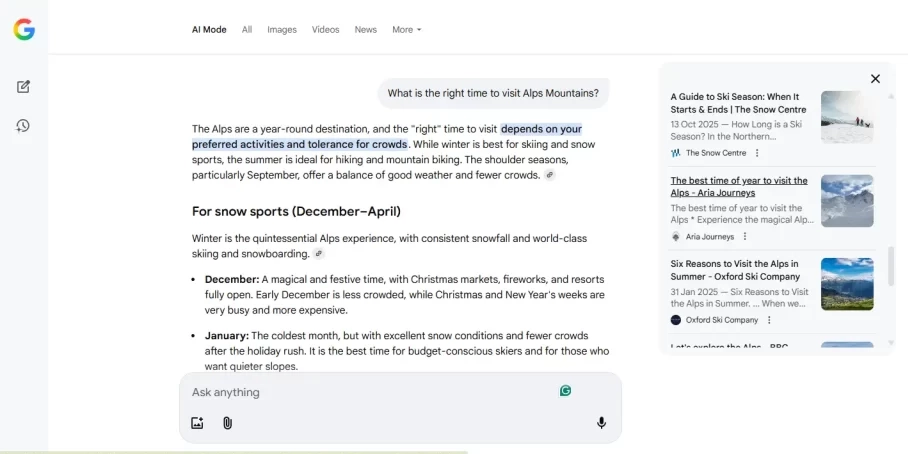
The AI assisted generative search has remodelled the entire SERP layer. The AI results section fulfills your questions by providing relevant answers that are AI synthesized after analysing numerous sites and sources.
The synthesized answer appears in a structured / encapsulated way, depending on the intent of your query. However, the generated answers are direct, informational and come with additional links as followups.
The AI response holistically covers the intent behind the search. You can experiment and see the suggested links as a plausible continuity of the AI generated response.
Example:
SEO Tips:
- Prioritize content towards user intent
- Modular breakdown of sections that independently answers where, when, how, why
- Keep an informative and welcoming tone with fact-rich content
- Cite the sources, link pages for ensuring authority
- Include FAQ section that cover multi-intent questions
4.Spam & Safety Filtering Layer
Google hates misinformation, spammy content and manipulative SEO attempts. The spam & safety filter later acts as vigilance against content of poor quality. It is employed to improve search quality and to ensure trustworthy, relevant contents on board.
This spam regulation layer is a part of the SpamBrain system which is continuously refined and updated by Google. It has millions of spam detection algorithms that effectively filters out contents like low quality AI contents, spammy sites, Malicious pages, Viruses and misinformation.
SEO Tips:
- Avoid AI-text duplication and auto-generated content farms
- Keep clean site architecture, HTTPS, and transparent authorship.
- Avoid hidden SEO tactics like keyword stuffing and parasitic SEO gains
- Ensure content readability and factual reliability
Knowledge Graph Layer
Similar to its name, this layer represents how each knowledge, information or facts are interlinked inside the grand Google ‘brain’. Knowledge graph layer is a massive semantic database.
The knowledge graph is technically similar to how the human brain accumulates facts and interrelates each other. The knowledge graph contains ‘Entities’ that represent how things are interrelated semantically.
For example, it frames relationships between facts, things, places, people and more
Beethoven— 5th symphony—vienna—deaf musician—Ode to Joy—…………
SEO Tips:
- Include topic clusters ( emphasize semantic relationship of keyword related to the topic)
- Link to relevant pages using semantic anchors.
- Maintain consistent metadata and schemas across all pages
6.MUM (Multimodal Understanding Layer)
Google’s Multitask Unified Model Algorithm (MUM) was introduced to expand the search performance and its quality. It is an AI driven update that offers diverse search results comprising the images, videos, structured data and texts. As a result, MUM can handle complex queries that were once required to perform multiple search queries.
MUM understands and has access to 75 regional languages, negating the linguistic barriers for global coverage.
SEO Tips:
- Use brand-author schema to link knowledge panels and enhance SGE trust.
- Refine the content for updates, changes or timely information– this enhances trust of freshness across AI crawlers.
- Provide proprietary description, alt text and title to the media contents.
- Write contextually relevant topics that come under the entity topic.
With a proper understanding of various Google systems, SEO can be structured with a holistic approach. Moreover, SEO strategies can be targeted to strengthen each layer individually. Understanding these algorithms and proper SEO integration can fortify your website’s presence and help boost SERP ranking.
Get Innovative Marketing insights, Advertisement strategies, Growth planning with Raysoft Marketing Experts.